
By Oksana Kishchuk, Abacus Data
At the beginning of May, Abacus Data conducted a national public opinion survey commissioned by the Rideau Hall Foundation. This survey was a follow-up to research that was conducted in February just a few weeks before the COVID-19 outbreak and was intended to understand how the initial pandemic response has changed public impressions of Canadian public institutions.
Here is what we found:
 So why, despite all that’s happened, are Canadians more optimistic about the direction of the country?
 Despite being in the spotlight, which doesn’t always produce positive evaluations, most Canadians have a positive view of public institutions’ initial response to the pandemic. While some remain consistent in their impression, one third of Canadians say the response to the pandemic has left them more confident about Canada’s institutions. And three quarters of Canadians think our institutions responded well. Only 14% say the response from Canada’s institutions has been poor.
Our survey also finds that more Canadians are associating positive attributes with our public institutions. 79% say our institutions are relevant (an increase of 7-points since February), 69% believe they unite Canadians (an increase of 10-points since February), and 75% describe them as accessible (up 6-points since February).
 The pandemic has created an opportunity for Canadians to interact with, and reflect on institutions in a way they may never have done before. And as a result, the pandemic has allowed us to recognize the importance of having strong institutions, built on solid foundations that are able to respond to crisis or just keep our country running smoothly.
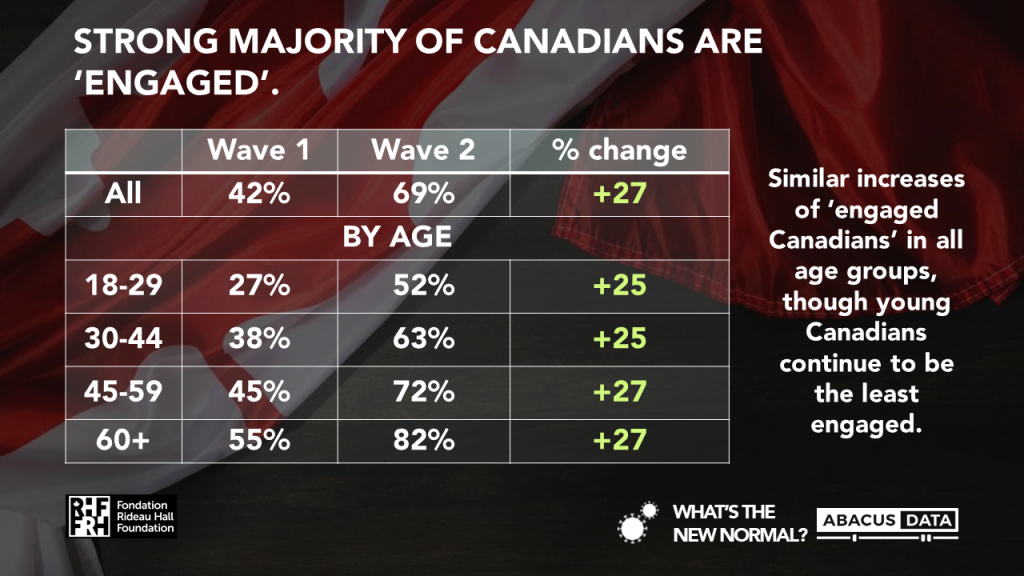 The COVID-19 pandemic has brought challenges for Canadians of all ages, though the impacts on young Canadians seem to be particularly tough. The unemployment rate is bleakest for this age group, and among students, summer job prospects have been severely affected. Given these impacts, it is noteworthy, and disheartening, that young Canadians continue to be the least engaged.
Also, while young Canadians have the most positive impressions of our country overall, they are also the least confident in Canada’s public institutions as a result of the pandemic.
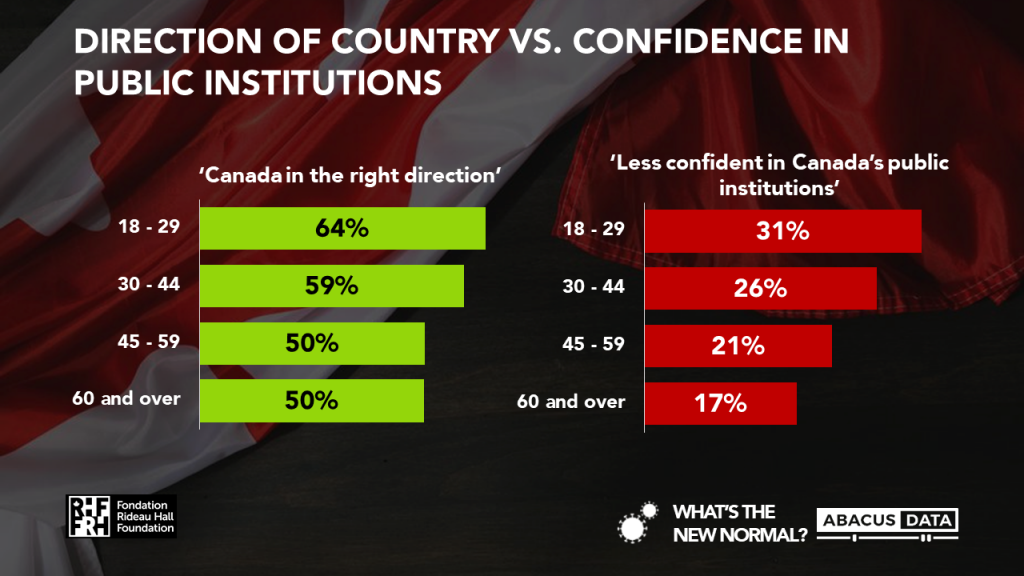 This suggests younger Canadians are not making the connection between the ‘Canada’ they see and the public institutions that make Canada what it is.
For most Canadians, public institutions = government.
There are many public institutions in Canada, serving Canadians in many different ways, but when asked what comes to mind when they think “public institution” most said government. We asked Canadians in an open-ended question what comes to mind when they think of the phrase public institutions. Top answers were:- Something run by government/government offices (30%)
- Schools/education (23%)
- Hospital/Healthcare (17%)
After Canada’s initial response to the pandemic, perceptions of ‘Canada’, especially among young Canadians were more positive.
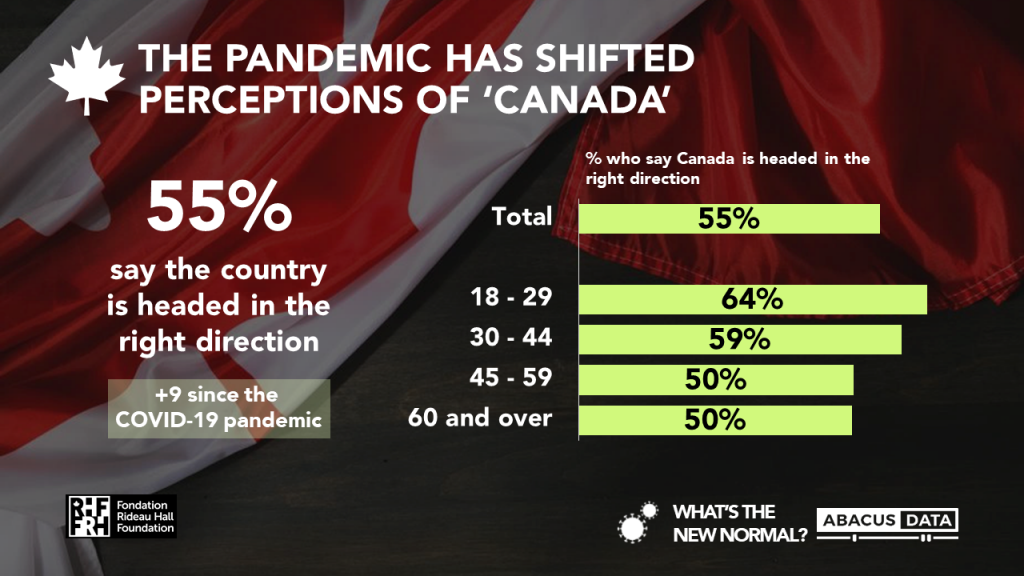
Since the pandemic started there has been a significant increase in the number of Canadians who say our country is headed in the right direction. In our survey:- 55% of Canadians say the country is headed in the right direction, a 9-point increase from February.
- Among different age groups:
- 64% of those 18-29 say the country is headed in the right direction.
- 59% of those 30-44 say the country is headed in the right direction.
- And 50% of those over 45 say the country is headed in the right direction.
So why, despite all that’s happened, are Canadians more optimistic about the direction of the country?
A strong initial response to the pandemic.
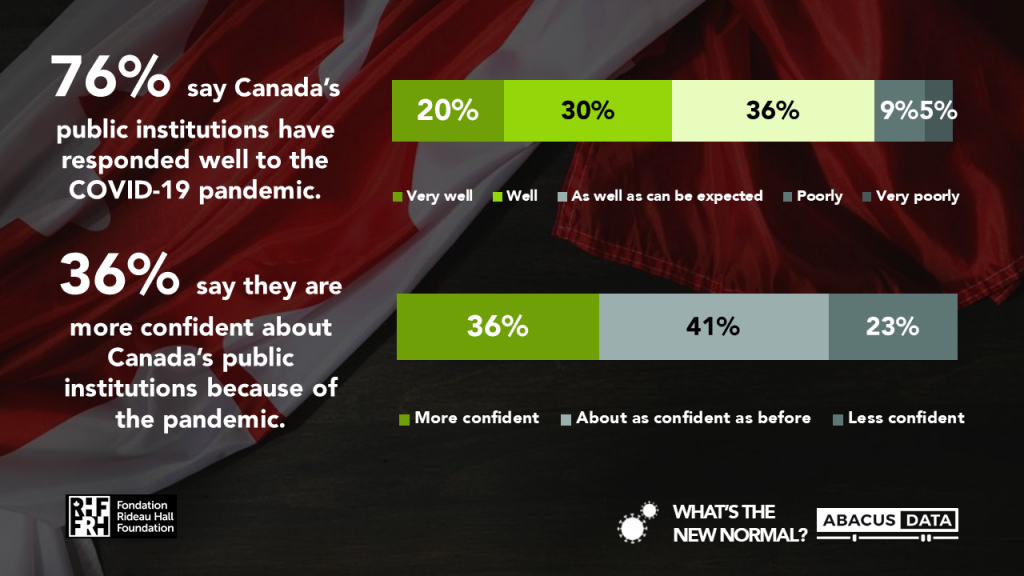
One possible answer is performance of the public institutions that responded and served Canadians during the pandemic.- 76% say Canada’s public institutions have responded very well/well/as well as can be expected to the COVID-19 pandemic so far.
- 36% say they are more confident in Canada’s institutions because of the pandemic. 41% are just as confident as they were before.
- 74% say they are paying more attention to the healthcare system while 58% are paying more attention to news organizations as a result of the pandemic.
- Half (53%) say they are paying more attention to their provincial legislatures, and 43% say the same about their municipal government.
- 42% of Canadians are watching the federal public service more closely, who reacted quickly to establish a number of emergency programs.
Despite being in the spotlight, which doesn’t always produce positive evaluations, most Canadians have a positive view of public institutions’ initial response to the pandemic. While some remain consistent in their impression, one third of Canadians say the response to the pandemic has left them more confident about Canada’s institutions. And three quarters of Canadians think our institutions responded well. Only 14% say the response from Canada’s institutions has been poor.
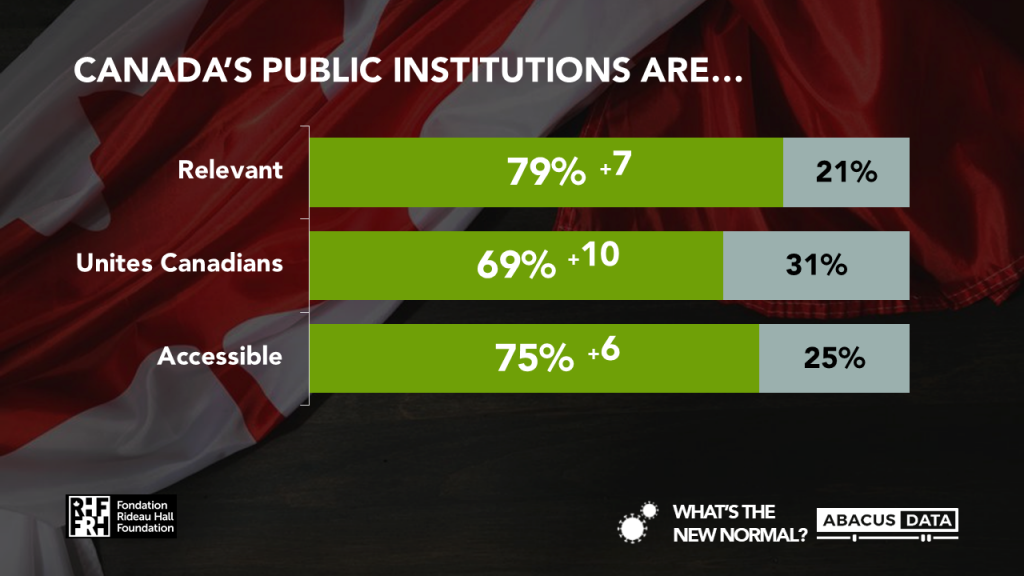
Our survey also finds that more Canadians are associating positive attributes with our public institutions. 79% say our institutions are relevant (an increase of 7-points since February), 69% believe they unite Canadians (an increase of 10-points since February), and 75% describe them as accessible (up 6-points since February).
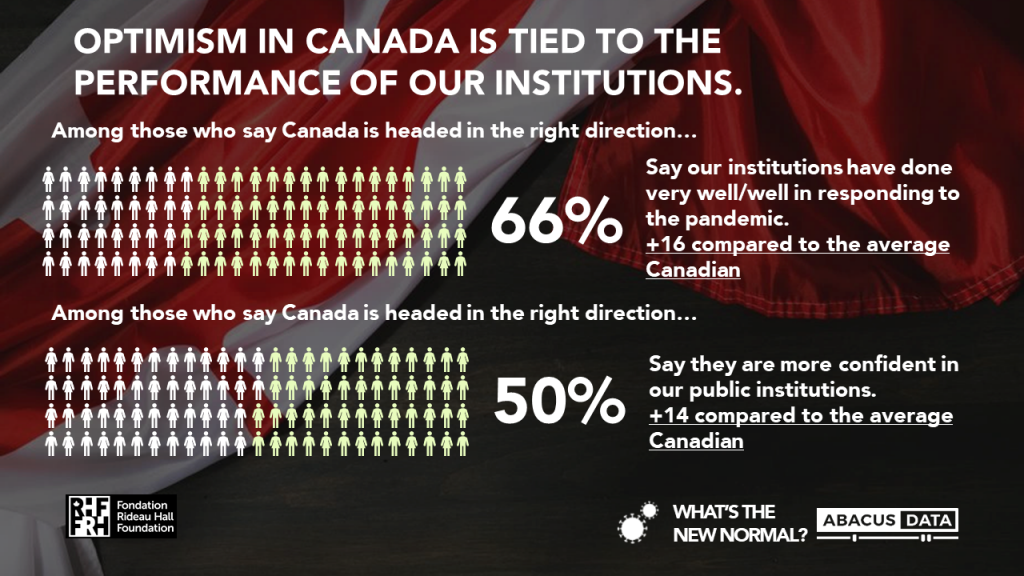
Having positive impressions of the country overall means having positive impressions of our public institutions.
Canadians who feel the country is headed in the right direction are even more optimistic and confident in Canada’s public institutions. When we look at only those who said the country is headed in the right direction, these Canadians are more satisfied with our institutions response to the COVID-19 pandemic and more confident in our institutions as a result.
The pandemic has created an opportunity for Canadians to interact with, and reflect on institutions in a way they may never have done before. And as a result, the pandemic has allowed us to recognize the importance of having strong institutions, built on solid foundations that are able to respond to crisis or just keep our country running smoothly.
THE PANDEMIC HAS ‘RE-ENGAGED’ MORE CANADIANS.
Aside from more positive impressions of Canada and our institutions, and increased interest in certain institutions, overall public engagement has increased significantly. One measure we often track is ‘engaged Canadians’, or those who are paying attention to news, politics and current events. Between the end of February and the beginning of April the number of ‘engaged Canadians’ increased a substantial 27 percentage points. While this level of engagement may not persist, the pandemic has clearly forced Canadians to become more engaged in their country, follow current affairs, and closely monitor what is happening around them. This may be a positive legacy of the pandemic.ENGAGEMENT IS STILL LOWEST AMONG YOUNG CANADIANS.
Although engagement has increased at least 25 percentage points for each age group, younger Canadians continue to be the least engaged, even during the pandemic. Those aged 18 to 29 are 30-points less likely to be engaged than those aged 60 and over.
The COVID-19 pandemic has brought challenges for Canadians of all ages, though the impacts on young Canadians seem to be particularly tough. The unemployment rate is bleakest for this age group, and among students, summer job prospects have been severely affected. Given these impacts, it is noteworthy, and disheartening, that young Canadians continue to be the least engaged.
Also, while young Canadians have the most positive impressions of our country overall, they are also the least confident in Canada’s public institutions as a result of the pandemic.
This suggests younger Canadians are not making the connection between the ‘Canada’ they see and the public institutions that make Canada what it is.